What Europe calls a barrier,
Hanoi calls a supplier.
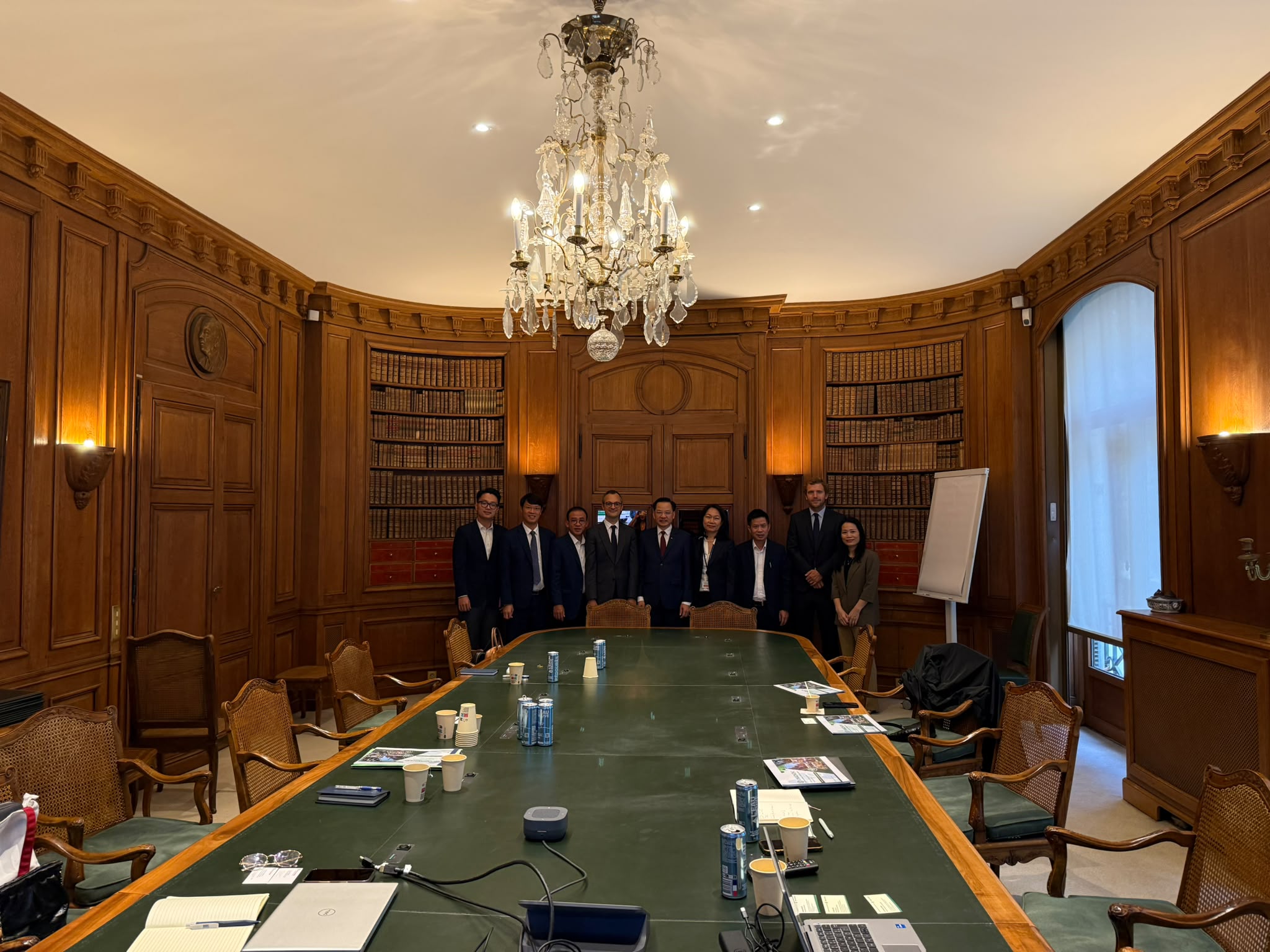
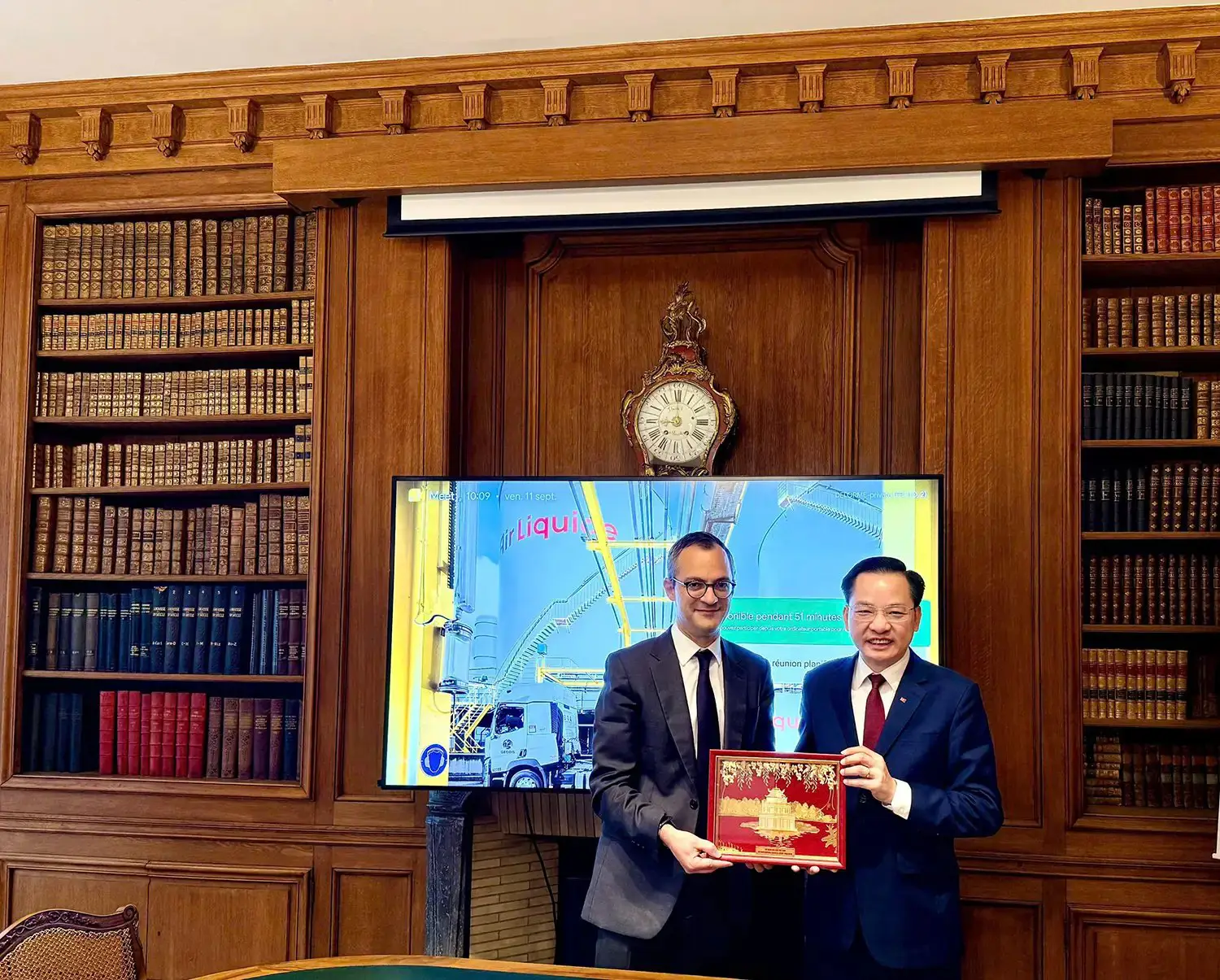
On 10 and 11 September, Liên prepared and accompanied a Vinachem delegation, from Vietnam's state chemical group, in Paris.
Three meetings, and a lesson about the market Europe's own rules are quietly creating.
Vinachem — Tập đoàn Hóa chất Việt Nam — is Vietnam's state chemical group. Thirty-three member companies across six lines of business: fertilisers, crop protection, basic chemicals, electrochemistry, rubber, and mining products. Two research institutes. A Vinachem delegation came to Paris in September.
Three meetings in two days: GreenTech, which specialises in natural active ingredients for cosmetics; Air Liquide, at headquarters; and Alternative Plastics. The group published its own account of the trip on 14 September.
Liên prepared and accompanied the French side of that visit. What follows is not a travel diary. It is what two weeks of preparation taught us about a market very few French companies are looking at.
The readBefore the target list, a question
The work did not start with a list of French groups to call. It started with a much simpler question: what is this delegation actually coming to buy?
Three facts, all from public sources, answer it.
01Their ammonia comes from coal
The group's two main urea plants make their ammonia by coal gasification rather than from natural gas. It is the most energy-intensive route, and the most carbon-intensive. That is not a setting anyone can adjust: it is built into the plants.
02Europe now prices that carbon at its border
The Carbon Border Adjustment Mechanism entered its definitive regime on 1 January 2026. A nitrogen fertiliser producer selling into Europe must declare the emissions embedded in the product and buy the matching certificates.
That is not only a cost. It is an obligation to measure, document and certify — which few Asian producers can yet meet on their own.
03Urea is a commodity
Thin margins, market prices, little to differentiate on. Hence an ambition visible in every public document the group publishes: move up the value chain. Non-agricultural nitrogen products, fine chemicals, medical and cosmetic chemistry.
Put together, those three facts describe a shared market context: the same regulation creates, on both sides, a need for technology and measurement.
The turnA constraint on one side, an order on the other
Seen from Brussels, the carbon border is protection: it stops European industry from being undercut by goods made without climate constraints.
Seen from Hanoi, it is an order to be filled. Someone has to sell Vinachem the means to comply: emissions measurement, certification, and above all the technology that brings the numbers down. It may as well be a European company.
That was the argument throughout the mission. It is also the one that opened the doors.
The marketWhere the money actually is
A coal-based ammonia plant runs on oxygen. You cannot gasify coal without very large volumes of pure oxygen, and ammonia synthesis requires pure nitrogen. Both come out of an air separation unit, one of the largest electricity loads on the site.
Improving that unit is among the most direct ways to bring down both the cost and the footprint of an ammonia plant. Air Liquide is the world's leading supplier of them, and had already provided the air separation technology for the Ninh Bình fertiliser plant. So the meeting did not start from zero. It started from a plant already running.
The rest follows the same logic. Low-carbon hydrogen, carbon capture and storage, data-driven plant operation: all of them are European seller's subjects as much as Vietnamese buyer's subjects.
The point: European regulation creates demand for technology, measurement and certification. That is a market for both sides.
The workWhat we did, in two weeks
Two people, two weeks, a deadline that would not move.
The starting brief was broad: the group wanted to meet French companies, with no list and no specification. The work was to translate it into precise targets. We sourced the companies, shortlisted seven, then cut the list down to what the group actually needed. Three meetings came out of it.
- A map of the group: its thirty-three companies, its six business lines, its live projects and its real constraints.
- A diagnostic note — the substance of this article — built entirely from public sources.
- A presentation pack in French and English, plus a one-page brief per target company, written from their point of view rather than ours.
- First contact at the right level in each company, then the preparation of each meeting.
- A seven-page French-Vietnamese interpreting brief, technical glossary included, for a delegation that spoke neither French nor English.
- Two days on the ground with them, in Paris.
The three meetings surfaced common interests and opened lines of cooperation. Nothing is signed at this stage. The relationship between the group and France continues, and we go on supporting it.
ConfirmedThree things we already believed
One warm introduction beats fifty cold calls. Two weeks of switchboard calls produced one well-argued refusal and a lot of silence. The meetings that happened came through people, by talking to the right person. The corridor is not worked from a database.
Knowing how to cut a list is what builds credibility. Seven companies shortlisted, three kept: the other four were set aside because they did not match what the group actually needed, and said to be so. That is the opposite of what an ordinary introducer does, which is to offer all seven to everyone. It is also why you get called again.
Technical precision is the price of entry. Pronouncing Phú Mỹ correctly. Knowing that ammonia sits under hydrogen and derivatives. Understanding why a cryogenics director is in the room. These are the details that separate a middleman from a counterpart, inside the first twenty seconds of a call.
The corridorThe other direction is less crowded
Vietnam is usually presented as a destination market: selling European brands to Vietnamese consumers. That is true, and it is most of what we do.
But the corridor runs both ways, and the other way is less crowded. A Vietnamese industry that must decarbonise to keep exporting is a market for European engineering, measurement, certification and technology. It is decided in Paris, at headquarters, not at local subsidiary level.
You do have to be in the room.
Source: account published by Vinachem on 14 September 2026, vinachem.com.vn. All diagnostic elements presented here come from public sources only.
Bespoke missions
A delegation to host,
an industrial partner to find?
Tell us what you are looking for on the other side of the corridor.
One conversation is enough for us to say whether it is doable, and how.